

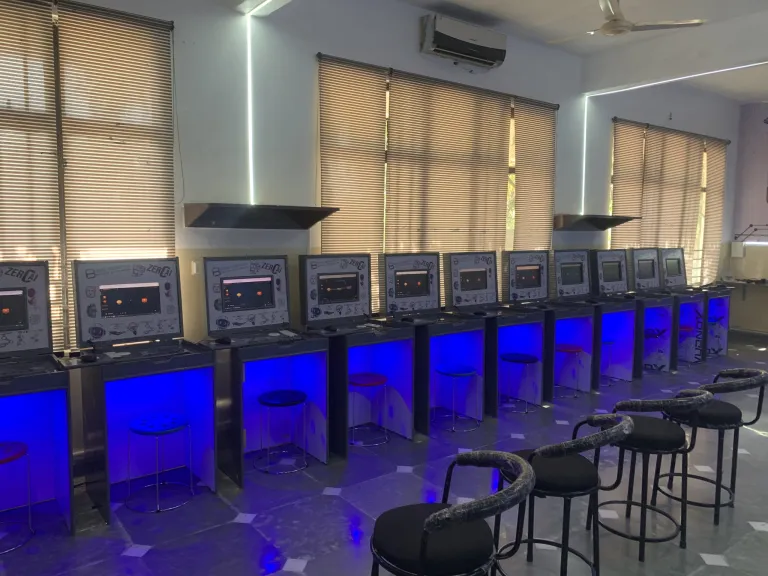
Zambian startup ZeroAI Technologies designs and delivers complete AI and robotics education lab environments for schools, helping schools educate children in these key subjects even in situations where there is no power or electricity.
Founded in 2014 by Lottie Mukuka, ZeroAI provides schools with complete lab setups that they can run themselves.
Each deployment includes custom-built lab furniture, Arduino and ESP32 hardware kits, IoT sensors, proprietary offline simulation software, a structured curriculum, and teacher training – all as one integrated package.
The core differentiator, Mukuka told Disrupt Africa, is that everything works without internet or reliable electricity.

“We built for the schools everyone else ignores — under-resourced, rural, or infrastructure-poor,” she said.
This is the gap ZeroAI is filling Schools across Africa and other emerging markets want STEM and AI education, yet mainstream ed-tech solutions usually require the internet, devices, and digital literacy that most schools simply do not have.
“Nobody was solving the offline, hardware-first, whole-lab problem at a price point schools could actually afford,” Mukuka said. “Our closest competitors are STEMROBO and Tinkerly — but they sell kits, not full environments, and none have our offline-first approach or teacher training depth. Internationally, no company does what we do at this price point for this market.”
The startup, which is completely bootstrapped, has already trained more than 10,000 students across 40 schools in Zambia, Zimbabwe, South Africa and India, and is now starting to agree infrastructure contracts, having agreed one in India to develop a full robotics lab. This is key to ZeroAI’s expansion plan.
“Complete delivery of the Punjab contract, use it as a reference case, scale across India’s school market, and re-enter Zambia with the proven lab model,” said Mukuka.
The startup monetises via three revenue streams – full lab deployment contracts, workshop and teacher training fees, and remote IT services.
“Training revenue has been consistent but modest — enough to sustain operations. We are pre-profit at institutional scale but the unit economics are sound – one full lab contract covers several months of operating costs,” Mukuka said.