


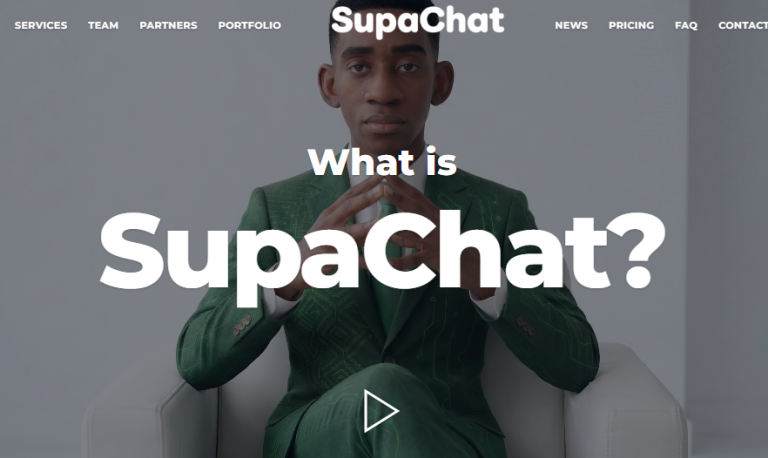
South African startup SupaChat Global enables businesses to deploy AI agents trained on their own products, pricing, brand voice, and customer service parameters, engaging customers across WhatsApp, web, Facebook and Instagram, in multiple languages, around the clock.
Founded last year, SupaChat is the “deployment layer” for AI in Africa.
“Big Tech builds the models and global SaaS builds the tools, but someone has to make AI actually work for a business operating on the ground. That is what we do,” founder and CEO Lindile Ndube.
The startup has three main products. Thuso is a multilingual AI concierge, live on WhatsApp and web, and supporting all official languages. Azi is an analytics agent, pulling cross-platform data into clear insights and real-time action items. And Khulu is an AI social media manager that helps brands leverage autonomous posts and power the creator economy.

“The principle behind all of it is the Agency Swap. Most software forces the business owner to serve the platform. We invert that. The platform serves the owner,” said Ndube.
While working as a strategy director at a global agency in 2023, Ndube had noted a gap in the industry for automating data analytics and delivering accountable media campaigns to clients at scale. After working on the idea for a few years while in different roles, SupaChat finally came into being last year.
“The gap I spotted was that adoption for AI was lagging at enterprise level, businesses were being left behind and outpaced by savvy individuals due to cost and technical barriers. Also, I noticed that Africa was not a priority market and figured out that if we take frontier tech and modify it for local nuances, we could make a difference,” Ndube said.
AI adoption is accelerating globally, and he said incumbents are starting to adopt SupaChat’s approach.
“But they treat chat as automation. Whereas, we treat it as intelligence. We compete on outcomes, not features or price, and have repositioned the category from chatbot tool to creator intelligence platform. Eleven local languages and data sovereignty are our core differentiators,” said Ndube.
“Honestly, when we experimented with GenAI integration inside WhatsApp back in 2023, there was no one offering this and that’s why we built it. We had already deployed GenAI experiments inside the platform before Meta even introduced Meta AI inside WhatsApp.”
The startup is self-funded, but Ndube said its clients are primarily advertisers with budgets and KPIs for innovation.
“We were fortunate to land a few lucrative deals with the likes of Unilever, MTN, Primedia and Schneider Electric, and that helped with R&D because each one of those blue-chip clients was looking for new and better ways to operate and AI was an interest,” he said.
“For example, we used our African payments system knowledge and built Primedia’s Rest of Africa business and AI powered loyalty programme app, where users can upload receipts from any retailer and earn points. This is a data collection strategy based on actual user behaviours, and the fact that we were able to use AI in a way that was not bound to retailer system integrations, which they avoided anyway, we found another solve by reverse engineering code that one of our team members had developed for a system that sends receipts directly to a user’s phone, which is now used by Dubai retailers.”
Another recent landmark is launching SupaChat Media with two partners, Media North and Phoenix Ads, the media arm of Transsion, reaching over 150 million monthly active users across more than 10 African markets.
“This partnership puts us in a position. We are also in advanced talks with one of South Africa’s most widely recognised youth media platforms to launch a creator-powered marketplace during SA Youth Month. They are trusting us to help them help young people monetise their talents with our tech. Think influencer marketing to the power of AI engagement,” said Ndube.
“We are at the inflection point because AI awareness has grown significantly as more and more businesses are starting to take AI seriously. We are starting to see a sharp growth in inbound calls and are in the middle of very exciting conversations with clients from various verticals.”
Though SupaChat focuses on South Africa, it does have the capacity to service clients from anywhere in the world.
“We are grounded in this market until we feel that our business health and fundamentals are robust. Only then will we consider external operations because my industry experience has taught me that the proper way to grow in our continent is to root in the markets and lean on local experts,” said Ndube.
SupaChat has two business models – licensing and subscriptions.
“Licensing made sense at first, but as competition is progressively becoming aggressive, and more recently from companies building the frontier models, who also realised that the money is not in the base models but in the utilities, we too have had to relook our own model and put emphasis on Managed AI Services (MAIS), charged on subscriptions and usage,” said Ndube.
“This is why we have intentionally removed adoption friction and enabled clients to onboard with zero code, which is something novel for the type of service we’re offering. According to projections we will be breaking even by September and hit our conservative double-digit profit margins by the close of 2026.”