


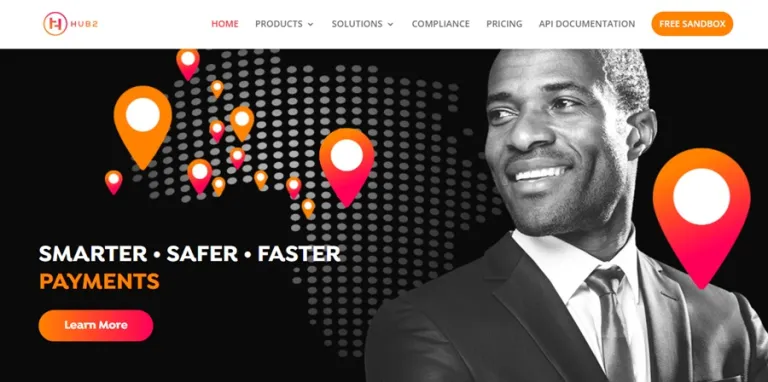
Fintech startup Hub2 is the payment infrastructure for the financial sector in Francophone Africa, and is already active in 12 countries across West and Central Africa.
Founded in 2019, Hub2 was founded in 2019 with a clear ambition – to solve the structural fragmentation of payment systems in Francophone Africa.
“The company was born from the observation that fintechs and digital platforms had to multiply technical integrations to operate across several markets. We therefore designed a unique API infrastructure to orchestrate different payment rails across multiple countries,” Jean-Rémi Kouchakji, co-CEO of HUB2, said.
“Think of us as a network of pipes used to transport water or gas; we build the network of “pipes” that circulate money. We are an orchestrator that allows neobanks, fintechs, financial institutions and corporates to offer seamless payment services to their end customers via a single API.”

This technological infrastructure addresses the fragmentation of payment systems, particularly in Francophone Africa, by simplifying technical integration and facilitating interoperability between local and regional players.
“Hub2 connects existing systems and reduces technical and operational complexity,” said Kouchakji.
When Hub2 launched, mobile money was seeing massive adoption, but infrastructures remained siloed. The main challenges were a multiplicity of non-interconnected mobile money operators, regulatory complexity between the UEMOA and CEMAC zones, and repetitive technical integrations for companies operating in more than one country.
“Africa doesn’t have a digital adoption problem; it has an interoperable infrastructure problem,” said Kouchakji. “We saw that systems remained closed silos. For a company, operating in 10 countries meant 10 different integrations. Hub2 fills this void by offering unified “piping” where the market is still fragmented.”
Given the extent of the impact, it is no surprise that traction has been strong.
“We currently serve neobanks, e-commerce platforms, corporates, financial institutions and money transfer operators across several Francophone African markets,” said Kouchakji.
Twelve markets, in fact. Hub2, which raised a EUR8 million (US$8.4 million) Series A in late-2024, claims to have an “unparalleled” transaction success rate exceeding 98 per cent, compared to a market average that can drop to 50 per cent. It is also seeing significant growth in processed volumes, and recently secured a key licence to support international remittance flows.
It has also signed a structural MoU with Ecobank that Kouchakji describes as an “historic milestone”.
“By connecting our 200 million mobile wallets to Ecobank’s digital platform, we are creating a financial highway across 32 markets. For a merchant, it means they can now operate regionally with the same ease as they do locally, backed by Ecobank’s regulatory solidity and Hub2’s technical agility,” he said.
“This is an infrastructure partnership, not just a commercial agreement. It creates a structural gateway between mobile money and banking ecosystems. It is an alliance of complementary strengths: the bank provides licenses, regulatory capital, and institutional roots. Fintechs provide technological agility, speed of innovation, and user experience. To become a serious player, one must embrace regulation. We are transitioning from startup status to a group of regulated entities, and this professionalism reassures our banking partners like Ecobank.
Focused on Francophone markets for now, Kouchakji said Hub2’s vision is actually pan-African.
“Today, we have the ambition to expand into other Francophone countries such as Guinea and the Democratic Republic of Congo (DRC). At the same time, we are preparing to launch in certain English-speaking markets in West and East Africa to meet the growing demand for interoperable payment solutions,” he said.
Hub2 monetises via commissions on transaction volumes, multi-country orchestration services, and value-added services related to integration, compliance, and settlement.
“We favour a scalable model aligned with our partners’ growth,” Kouchakji said.
The main challenges faced so far have been multi-jurisdictional regulatory complexity, the technological differences between local systems, and the need to educate the market on the value of a unified infrastructure.
“These challenges confirm the absolute necessity for an interoperable regional infrastructure,” said Kouchakji.
“Financial inclusion is a collective fight against cash and exclusion. It relies on connectivity. We must work hand-in-hand: banks, regulators, governing bodies, local authorities and fintechs. Fintechs bring agility, but we are not “pirates”; we must structure ourselves to build lasting financial sovereignty in Africa.”