


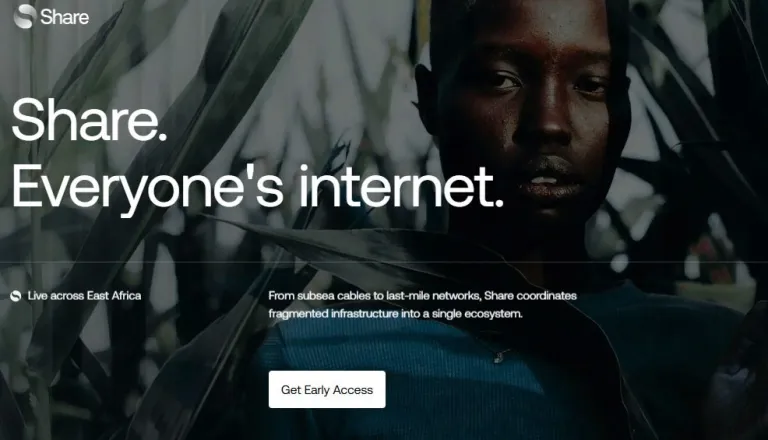
Kenyan startup Share, which launched an open-access network in Mombasa a year ago, is now reaching over eight million people and has expanded operations to Nairobi.
The open-access network that Share is building brings together Africa’s existing internet infrastructure into a single, shared ecosystem.
“Today, there’s no shortage of fibre, subsea cables or data centres across the continent; the challenge is that they operate in silos, making it difficult for independent ISPs to access capacity efficiently,” Luis Munoz Aycart, co-founder of Share, said. “We come in and aggregate that underutilised infrastructure and make it accessible through one network.”
ISPs can plug into Share without upfront commitments and immediately access high-speed bandwidth, often improving speeds by up to 100x without increasing their costs.

“You can think of Share as the “brains” of a massive shared network, that expands the capacity from within data centres to the edges, while ISPs simply plug in and deliver their service to end users in the last mile,” Aycart said.
In areas where infrastructure gaps exist, Share also has the licensing and operational capability to deploy the necessary infrastructure itself. The result is a neutral, shared network that allows ISPs to deliver faster, more affordable internet — without having to build everything from scratch.
“And the mission, to build Africa’s largest internet network,” said Aycart.
Aycart and his co-founders – brother Jose Munoz Aycart and best friend Omar Pederzoli – had originally moved to Kenya from New York with the intention of building an ISP.
“But very quickly, we realised that delivering fast, reliable internet at the end-user level was nearly impossible – not because the infrastructure didn’t exist, but because it wasn’t coordinated well enough to actually get people online,” Aycart said.
Africa, where 600 million people across the continent remain unconnected to the internet, has made significant investment in fibre, subsea cables, data centres and wireless networks, but they are fragmented.
“On one side, large infrastructure providers have excess capacity but limited access to the fragmented market. On the other, there are tens of thousands of independent ISPs that have strong demand but can’t access wholesale capacity without large upfront commitments or restrictive contracts,” said Aycart.
That is the gap Share addresses.
“We act as a neutral, open-access layer that connects both sides – enabling infrastructure providers to better monetise their assets, while allowing ISPs to scale faster and deliver significantly better speeds. This allows for a system that is far more flexible and scalable than other systems, making the end-user enjoy a faster, more reliable internet experience,” he said.
Uptake has been extremely strong on both sides of the network.
“On the supply side, we’ve secured buy-in from 12 major infrastructure providers, giving us access to significant capacity and fibre infrastructure across Kenya. On the demand side, we have many ISPs on a waitlist, representing more than 100,000 end users, while currently onboarding and activating 50,000 users into the network,” said Aycart.
Venture-backed, Share raised a pre-seed round in early 2025 and recently closed a larger seed round led by Greenfield Capital, alongside several other early-stage investors. It is now operating in both Mombasa and Kenya, but planning further expansion.
“From there, we’re expanding nationwide before the end of the year, while also pursuing licenses in several neighbouring countries. Our goal is to establish a presence across many of East and South Africa’s key markets by late 2026,” said Aycart.
“One of the advantages of our model is that expansion doesn’t require building infrastructure from scratch. In many cases, it’s activating existing capacity, establishing presence in a data center and turning on the network.”
Share operates on a platform fee model. ISPs process payments through its platform, and Share takes a percentage of each end-user transaction.
“That structure allows ISPs to access unlimited connectivity without upfront costs, while simplifying payments across the ecosystem,” Aycart said.
“Beyond connectivity, we’re also building a financial coordination layer – helping ISPs better manage capital and unlocking additional financial services over time.”
In terms of traction, Share’s initial focus has been on building network coverage.
“In just four months, we’ve reached a footprint reaching over 100 ISPs and more than eight million people,” said Aycart.
“We’re now in the commercial launch phase, onboarding our first 50,000 users. Based on current growth, we expect to process US$12 million in annualised volume by the end of 2026, making Share the fastest growing internet network in Africa.”