



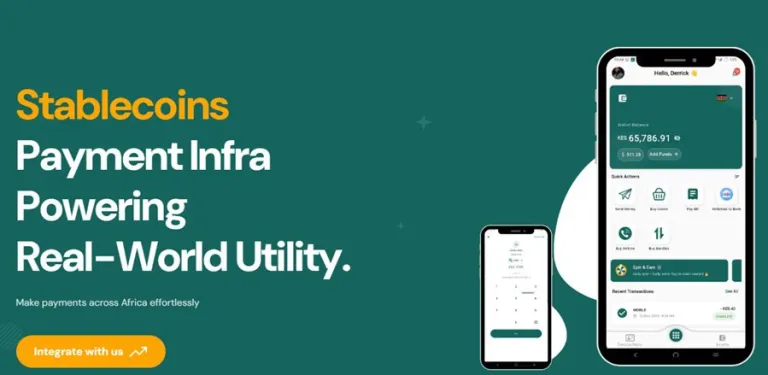
Kenyan startup Pretium is a stablecoin-powered payment infrastructure that bridges the blockchain ecosystem with mobile money and banking rails across Africa, enabling USDT and USDC to be spendable on everyday payments.
Founded in 2024, Pretium stemmed from the frustrations experienced by CEO and co-founder Derrick Bundi, who at that time was paid in stablecoins, specifically USDT. However, he couldn’t spend that USDT directly.
“Having worked in fintech, building financial tools and services across multiple African markets, this limitation didn’t make sense to me. Why couldn’t a digital asset designed for value transfer be used for everyday expenses? Instead, I had to rely on P2P platforms to off-ramp into local currency before making payments,” Bundi told us.
“To make matters worse, most P2P merchants were unwilling to process small USDT transactions and those who did often offered poor exchange rates, making the experience both inefficient and costly.”

While most of Pretium’s competitors focus on crypto on and off-ramps, enabling users to buy and sell digital assets, Bundi said this stops short of real-world utility.
“Pretium takes a different approach, bridging that gap by enabling direct, everyday spending with stablecoins,” he said.
The startup does this with two products – a consumer app, and B2B API services.
“At the consumer level, individuals use stablecoins to pay directly for everyday expenses such as shopping, groceries, fuel, rent, and school fees,” Bundi said.
“At the business level, partners tap into our payment protocol – B2B API – to access stablecoin-to-fiat liquidity and vice versa, as well as last-mile payouts, without the hassle of integrating multiple PSPs or having siloed funds in different markets.”
The approach has proven popular. Pretium has processed over US$6 million in transaction value so far, with more than 40 businesses leveraging its B2B APIs for payments across Africa. It also has 49,000 users relying on its Pretium app for their everyday payments.
“We are on track to surpass US$10 million in transaction value soon, driven by strong growth over the past few months,” said Bundi.
Pretium is currently operating in six African countries – Kenya, Uganda, Ghana, Nigeria, Malawi and DRC – with rapid expansion underway across other countries within the continent. With that in mind, the startup – which generates revenue by applying a fee on the exchange spread for transactions processed on its platform – is looking for additional capital.
“We have previously been funded and we are now raising additional capital to fuel our expansion within the continent as well as acquisition of relevant payments and crypto licenses,” said Bundi.
He said unclear regulations around digital assets have been the biggest challenge the startup had faced so far.
“In many of our target markets, there are still no clear laws governing the use of stablecoins and digital assets for payments, which creates uncertainty around compliance, partnerships with financial institutions and long-term scalability,” he said.
However, at the same time, regulatory momentum is building across the continent.
“Countries like Kenya, Rwanda and Ghana are actively working toward establishing digital asset regulations, which is a positive signal for the industry. However, until these regulations are formalised and are especially friendly to the homegrown solutions or local players, navigating differing requirements across multiple markets remains a key operational challenge for us,” said Bundi.